One-Arm Handstand with a straight (stacked) line Jacklyn Dougherty dance photo
What Is This Dance Move Called?
Exploring the One-Arm Handstand in Dance
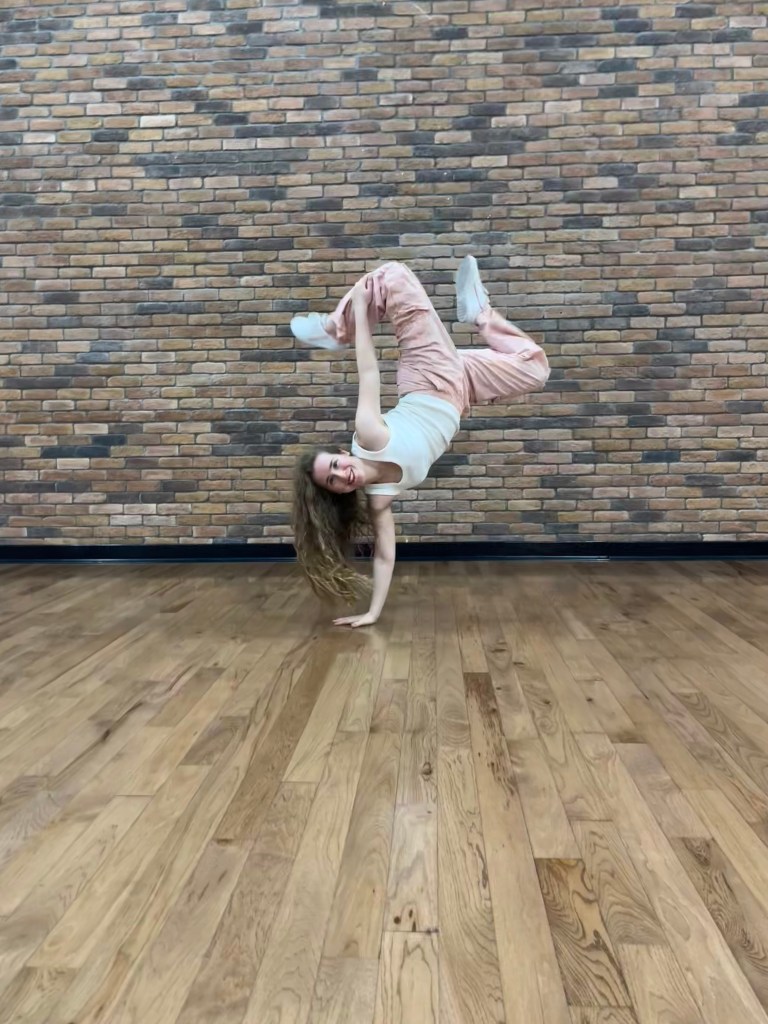
At first glance, a one-arm handstand looks almost effortless—suspended, calm, and balanced. In reality, it’s one of the most demanding skills a dancer can perform. The images above capture two variations of the same foundational movement: the one-arm handstand.
While the name sounds simple, this move carries different meanings, styles, and expectations depending on the dance world you’re in.
The One-Arm Handstand (Foundational Name)
Across dance, gymnastics, acrobatics, and yoga, this position is known as a one-arm handstand. It requires the dancer to balance their entire body weight on a single arm while maintaining control through the shoulders, core, hips, and legs.
This move demands:
- Significant upper-body and shoulder strength
- Deep core engagement
- Wrist stability and alignment
- Mental focus and balance
It’s a true test of both physical and technical control.
One-Arm Handstand Freeze (Hip-Hop & Breaking)
In hip-hop and breaking culture, the move is often referred to as a one-arm handstand freeze. A freeze is a pose that “hits” the music—paused in time to emphasize a beat, lyric, or transition.
Because the dancer holds the position briefly rather than flowing through it, the freeze highlights:
- Strength and confidence
- Musicality
- Personal style
In this context, the one-arm handstand is both athletic and expressive.
Straight-Line (Vertical) One-Arm Handstand
The second image shows a straight-body or stacked one-arm handstand. Here, the dancer’s body forms a clean vertical line from the supporting hand through the shoulders, hips, and ankles.
This version is especially valued because:
- The body is fully aligned and controlled
- The legs are together and extended
- The free arm is used for balance and aesthetics
This variation is more technical and strength-driven than stylized versions and is often used in training, performance photography, and contemporary choreography.
Stylized Variations in Dance
Dancers often modify the one-arm handstand to suit different styles. A common variation includes:
- Grabbing one leg
- Opening the hips
- Bending or scissoring the legs
These stylized shapes are popular in contemporary, jazz-funk, and fusion choreography because they add fluidity, personality, and visual interest while still demanding high-level strength.
How This Move Differs from Similar Inversions
Although it may look similar to other floor-based balances, the one-arm handstand is distinct:
- It is not an airbaby, which uses the elbow pressed into the torso
- It is not head-supported
- It does not rely on both hands
All balance comes from a single arm and a controlled body line.
Why Dancers Train This Move
The one-arm handstand is more than a trick—it’s a statement. Dancers use it to:
- Demonstrate strength and mastery
- Create dramatic moments in choreography
- Transition into floorwork, spins, or presses
- Build confidence in inverted movement
It’s also a powerful tool for developing overall body awareness and stability.
Final Thoughts
Whether held as a freeze, stacked into a perfect vertical line, or stylized with expressive leg shapes, the one-arm handstand represents the intersection of artistry and athleticism in dance. It’s a move that demands patience, discipline, and respect for the body—but when mastered, it becomes a striking expression of control and freedom.
Much Love Jacklyn Dougherty