Complete Ballet Twin Terms Teaching Guide – Master Edition
by Ballerina Jacklyn Dougherty & Dr. Joni Dougherty Ed.D.
(Visit JacklynDougherty.com for the full Ballet Foundations Collection.)
✨ Dedication
Dedicated to every dancer who listens, learns, and loves the music of motion.
With gratitude to my students and teachers who continue the lineage of grace.
💬 Author Preface – Why Twin Terms Matter
Ballet Twin Terms began as my way to teach clarity through contrast — to help dancers think in pairs, feel in opposites, and find artistry through awareness. When a dancer knows what something is and what it isn’t, they begin to move with purpose. Each twin in this guide reveals how opposites work together to create balance, precision, and expression. This collection was created for every dancer, teacher, and dreamer who finds beauty in structure and joy in understanding.
— Jacklyn Dougherty
🗣 French Pronunciation Reference
Tahn-dew (Tendu), Duh-gah-jay (Dégagé), Pl’yay (Plié), Swee-sohnn (Sissonne), Kwah-zay (Croisé), Eh-fah-say (Effacée), Soo-soo (Sous-sus), Soh-bruh-soh (Soubresaut)
🌸 PART I – FOUNDATION TWINS
(Building the base of control and awareness.)
Tendu / Dégagé – Tendu slides along the floor; Dégagé lifts off it.
💭 Think: Tendu “stays,” Dégagé “goes.”
🎯 Technique Focus Tip: Brush and stretch through every inch of the foot.
Plié / Fondu – Plié bends both knees; Fondu bends one.
💭 Think: Plié—two knees say “we,” Fondu—one knee says “me.”
🎯 Technique Focus Tip: Ground the heels; maintain turnout through both knees.
Relevé / Élevé – Relevé rises from a plié; Élevé rises without.
💭 Think: Relevé “rolls,” Élevé “elevates.”
🎯 Technique Focus Tip: Feel energy lift through the arches; balance from the core.
Relevé en Cinquième / Relevé en Première – Fifth tight vs first open.
💭 Think: Fifth “builds control,” First “builds balance.”
🎯 Technique Focus Tip: Fifth for strength, First for symmetry.
Sauté / Assemblé – Sauté jumps in place; Assemblé joins legs in air.
💭 Think: Sauté—solo hop; Assemblé—assemble together.
🎯 Technique Focus Tip: Land through plié for quiet control.
💫 PART II – INTERMEDIATE & DIRECTION TWINS
(Developing clarity, rhythm, and space awareness.)
Passé / Retiré – Movement vs position.
💭 Think: Passé “passes,” Retiré “rests.”
🎯 Technique Focus Tip: Glide past the knee; balance in stillness.
Balancé / Waltz Step – Side rock vs traveling turn.
💭 Think: Balancé sways; Waltz glides away.
🎯 Technique Focus Tip: Keep upper body lifted as rhythm flows.
Bourrée Couru / Pas de Bourrée – Run vs build.
💭 Think: Couru “runs,” Bourrée “builds.”
🎯 Technique Focus Tip: Small precise steps keep travel seamless.
Croisé / Effacé – Crossed vs open body line.
💭 Think: Croisé “conceals”; Effacé “exposes.”
🎯 Technique Focus Tip: Hold alignment; use épaulement gracefully.
Adagio / Allegro – Slow vs lively.
💭 Think: Adagio “adores,” Allegro “leaps.”
🎯 Technique Focus Tip: Expand through time; react with rhythm.
🌹 PART III – ADVANCED TECHNIQUE TWINS
Ciseaux / Sissonne – Scissor split vs scissor split that closes.
💭 Think: Ciseaux “splits and stays,” Sissonne “splits then closes.”
🎯 Technique Focus Tip: Extend fully in the air, land with intention.
Arabesque à Terre / Arabesque en l’Air – Grounded vs lifted.
💭 Think: One draws, one soars.
🎯 Technique Focus Tip: Keep extension through hip and spine.
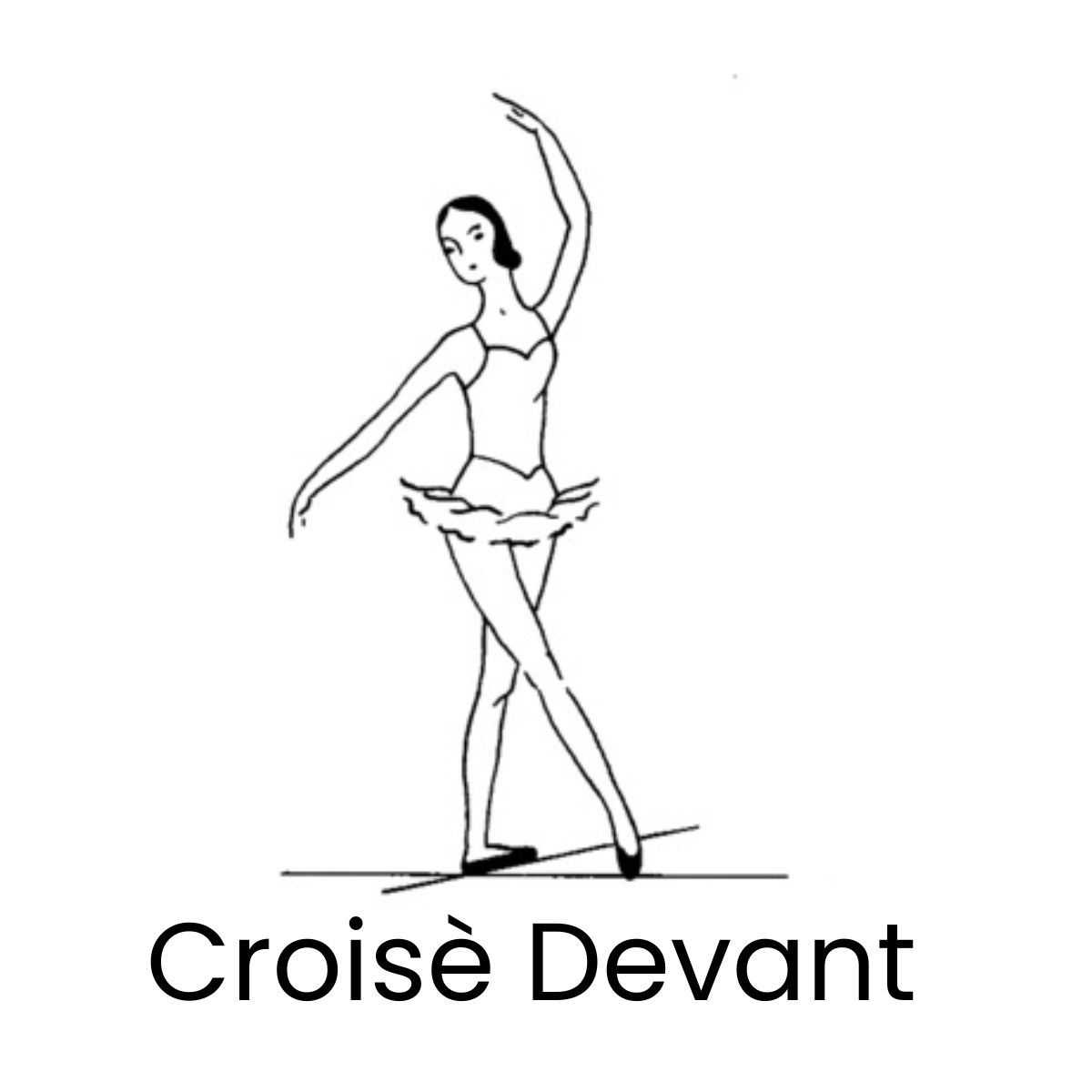
Croisée Pose Devant / Effacée Pose Devant – Crossed vs open.
💭 Think: Croisée “conceals,” Effacée “reveals.”
🎯 Technique Focus Tip: Keep diagonal alignment and eye focus matching the pose.
Demi Seconde Arms / Grand Seconde Arms – Low open vs wide open.
💭 Think: Demi Seconde “holds,” Grand Seconde “spreads.”
🎯 Technique Focus Tip: Round through elbows; open through chest.
Adagio Balance / Pirouette Balance – Stillness vs coiled energy.
💭 Think: Adagio “holds,” Pirouette “prepares.”
🎯 Technique Focus Tip: Center weight evenly before rotation.
💠 PART IV – PERFORMANCE & STAGE TWINS
Grande Révérence / Petit Révérence – Formal vs informal bow.
💭 Think: Grande “bows to the art,” Petit “greets the moment.”
🎯 Technique Focus Tip: Lead with heart, finish with calm breath.
🎓 PART V – CECCHETTI VOCABULARY TWINS
Temps Lié / Tombé Pas de Bourrée – Transfer vs linking step.
💭 Think: Lié “melts,” Bourrée “builds.”
🎯 Technique Focus Tip: Smooth transitions keep flow continuous.
Assemblé Soutenu / Assemblé Élancé – Sustained vs darted assembly.
💭 Think: Soutenu “holds,” Élancé “shoots.”
🎯 Technique Focus Tip: Land in Fifth; control tempo.
Petit Battement Serré / Petit Battement Simple – Close vs open beats.
💭 Think: Serré “sparkles,” Simple “shapes.”
🎯 Technique Focus Tip: Keep working leg close to ankle; control rhythm.
🎭 PART VI – MIME & EXPRESSION TWINS
Port de Visage / Port de Regard – Head vs eyes.
💭 Think: Visage “frames,” Regard “focuses.”
🎯 Technique Focus Tip: Keep emotion clear, subtle, alive.
Gesture Literal / Gesture Symbolic – Direct vs poetic mime.
💭 Think: Literal “shows,” Symbolic “suggests.”
🎯 Technique Focus Tip: Use space, timing, and pause to tell story.
🎼 PART VII – MUSICALITY TWINS
Tempo Rubato / Tempo Rigoureux – Free vs strict tempo.
💭 Think: Rubato “breathes,” Rigoureux “drives.”
🎯 Technique Focus Tip: Match phrasing to feeling; maintain rhythm’s truth.
Syncopé / Régulier – Off-beat vs steady.
💭 Think: Syncopé “surprises,” Régulier “stabilizes.”
🎯 Technique Focus Tip: Accent emotion, not just count.
🕊 PART VIII – PARTNERING & ENSEMBLE TWINS
Promenade / Pivot – Guided vs self-turn.
💭 Think: Promenade “partners,” Pivot “powers.”
🎯 Technique Focus Tip: Share balance; maintain tension-free coordination.
Lift / Assist – Carry vs support.
💭 Think: Lift “leads,” Assist “aids.”
🎯 Technique Focus Tip: Engage core, not arms alone; communicate clearly.
Spot / Focus – Technical gaze vs expressive intention.
💭 Think: Spot “finds,” Focus “feels.”
🎯 Technique Focus Tip: Use eye direction for precision and artistry.
🩰 PART IX – TEACHER CUE GLOSSARY
| Cue | Meaning | Purpose |
| “Lengthen, don’t lift.” | Stretch upward without tension. | Prevents neck strain. |
| “Soften your plié.” | Relax before rebound. | Builds buoyancy. |
| “Brush to brilliance.” | Clear articulation through foot. | Strengthens precision. |
| “Knees over toes.” | Aligns safely. | Maintains turnout. |
| “Rise through the arch.” | Lift energy through feet. | Improves balance. |
| “Eyes before arms.” | Lead focus before motion. | Connects artistry. |
| “Stay tall in descent.” | Keep posture descending. | Refines endings. |
🔠 PART X – CERTIFICATION ALIGNMENT CHART
| Cecchetti Grade | Key Twin Terms | Focus |
| Grade 1 | Plié / Fondu, Tendu / Dégagé | Coordination |
| Grade 2 | Passé / Retiré, Assemblé / Sissonne | Balance & control |
| Grade 3 | Croisé / Effacé, Arabesque lines | Presentation |
| Grade 4 | Ciseaux / Sissonne, Adagio / Allegro | Power & musicality |
| Intermediate | Épaulement / Inclinaison | Expression |
| Advanced | Adagio Balance / Pirouette | Performance artistry |
🏛 PART XI – NATIONAL METHOD VARIANTS & SYNONYMS
| Concept | Vaganova | Cecchetti | Royal Academy (RAD) | Balanchine | 💭 Think About Tip |
| Foot-to-knee position | Passé | Retiré | Retiré | Passé | Passé “passes,” Retiré “rests.” |
| Quick linking step | Pas de Bourrée | Pas de Bourrée | Bourrée | Pas de Bourrée (faster tempo) | All mean “link,” Balanchine adds “speed.” |
| Rise / Lift | Relevé | Élevé (Relevé with plié) | Rise | Relevé (snapped up) | Same idea — different start. |
| Outward circle of the leg | Rond de jambe en dehors | Rond de jambe en dehors | Rond de jambe en dehors | Rond de jambe en dehors (larger arc) | All circle; Balanchine stretches space. |
| Turning leap | Grand Jeté en tournant | Tour Jeté | Grand Jeté en tournant | Split Jeté en tournant | All turn; Balanchine opens the line wider. |
| Arabesque arm shape | First Arabesque | First Arabesque | First Arabesque (varies) | Arabesque Penché extension | Each defines line differently — all lengthen to infinity. |
| Port de bras energy | Soft wave | Balanced frame | Classical roundness | Linear lift | Style shapes the emotion — all share grace. |
✨ Teaching Note:
This helps teachers translate across Cecchetti, Vaganova, Royal Academy, and Balanchine — the vocabulary shifts, but the principles stay true.
💖 What Is the Difference: Sous-sus vs Sus-sous
Sous-sus – Draw heels and toes together into a tight Fifth on relevé, emphasizing “under-over” alignment.
Sus-sous – Same physical position, but executed “over-under” in some schools (often Balanchine).
💭 Think: “Scoop up, squeeze tight — Sous-sus takes flight.”
🎯 Technique Focus Tip: Keep inner thighs zipped, heels pressed, spine elongated.